• Skip to main content
  • Skip to primary sidebar
  • Skip to footer

Las Vegas Strip Luxury Real Estate

Luxury High-Rise Specialist with 30+ Years Experience

  • Discover Amazing Las Vegas Strip High Rises
  • Buy
    • Find A Home In Las Vegas
    • How to Buy a Home in Las Vegas
  • Home Evaluation
  • Properties
  • About Us
  • Faq
  • Resources
  • Blog
You are here: Home / 2026 / Archives for February 2026

Archives for February 2026

Feb 04 2026

It’s Getting More Affordable To Buy a Home

There’s finally a little good news for anyone who’s been priced out or sitting on the sidelines.

Buying a home is getting more affordable.

Monthly payments have started to come down, and the squeeze buyers have been feeling for the past few years is slowly loosening. Now, that doesn’t mean everyone can suddenly afford a home, but with how tough the market’s been, the improvement we’re seeing matters.

Affordability Is Finally Moving in the Right Direction

One of the best ways to see this shift is by looking at how much of a household’s income it takes to buy a home.

According to Zillow, housing is typically considered affordable when it takes 30% or less of your monthly income to cover your expenses. That includes your mortgage payment, taxes, insurance, and basic maintenance.

For the past few years, the math was well above that threshold, and it made buying a home unachievable for many. But now, we’re slowly moving back toward a balance. Zillow research shows it’s taking less of a typical household’s income to buy a home than it did just a few years ago (see graph below):
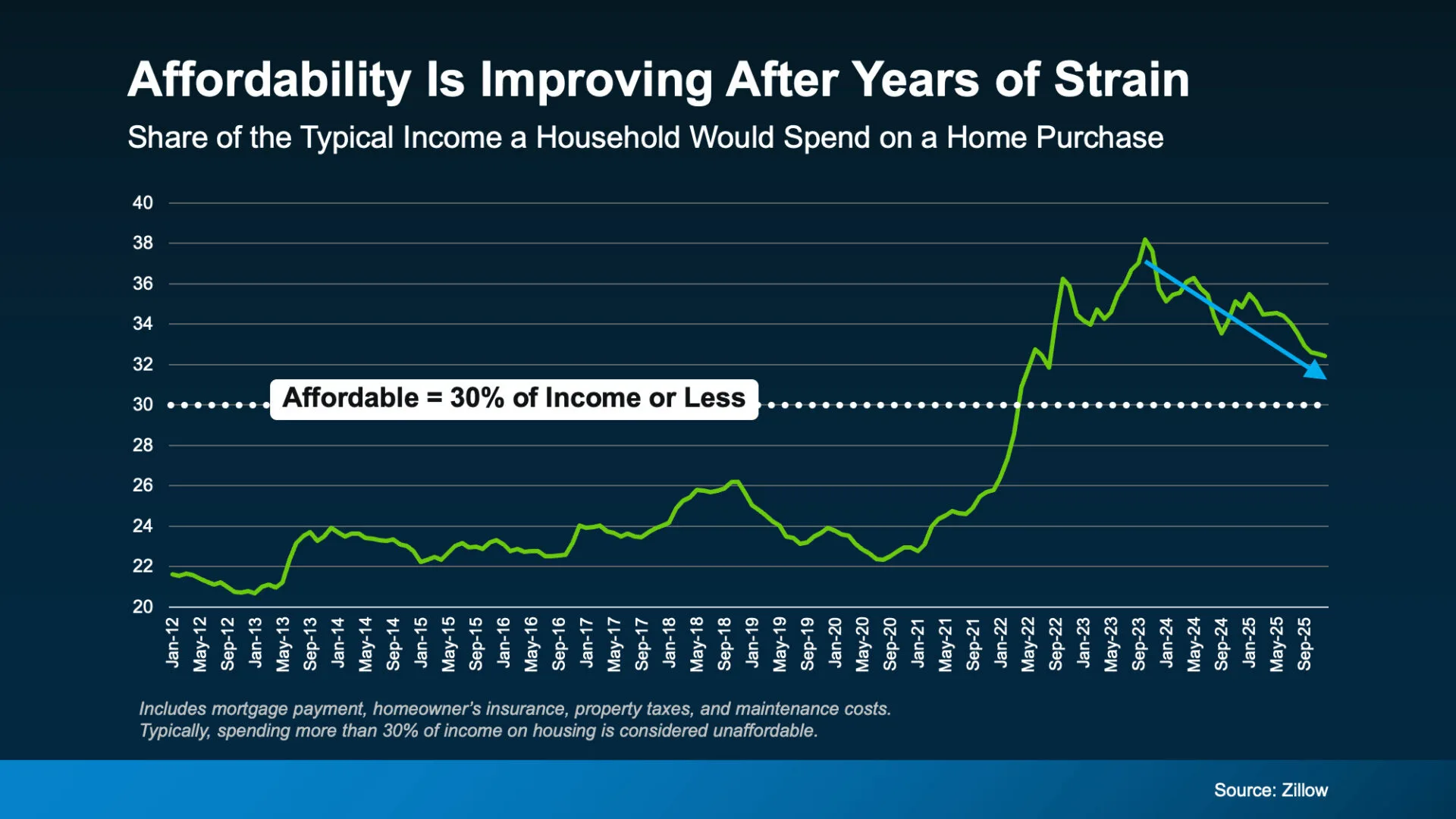
a graph with green line and white textNow, we’re not all the way back to Zillow’s threshold of 30% of your income or less, so affordability is still tight. But things are trending in the right direction.

Why Affordability Is Improving

So, what’s driving the change? A lot of the focus lately has been on mortgage rates and how much they’ve come down over the course of the past year. But that’s not the only factor working in favor of buyers right now. Here are three trends benefiting buyers today: 

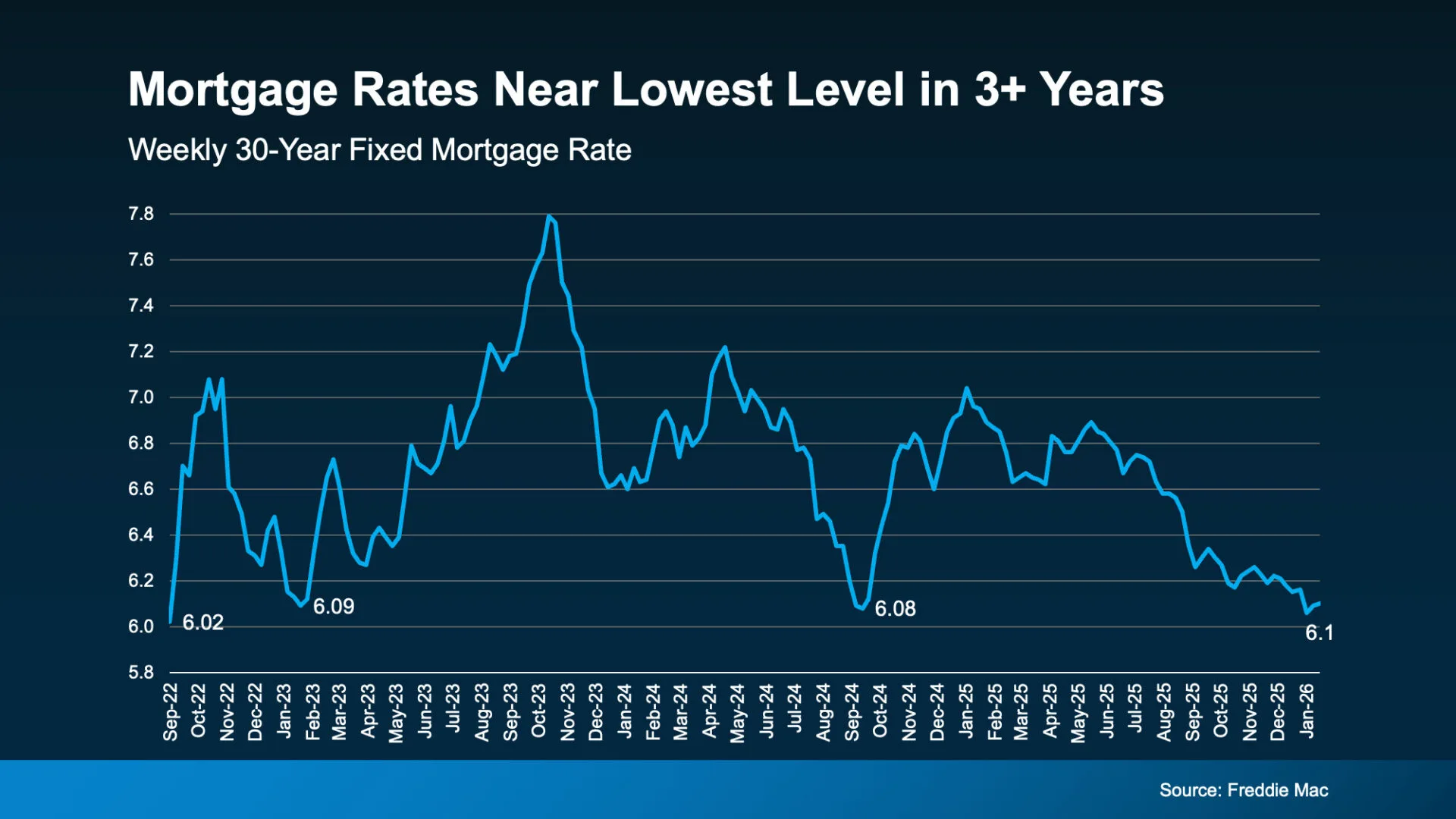
1. Mortgage rates have eased. Rates are near their lowest level in more than three years, which helps lower monthly payments (see graph below):
a graph of a low interest rate

2. Home price growth has cooled. Prices aren’t falling nationally, but they’re growing much more slowly than they were a few years ago. That means buyers today aren’t facing the same sharp jumps in purchase prices, which helps keep monthly payments more manageable – and buying more predictable. 

3. Wages are growing faster than home prices. This one matters a lot. As Mark Fleming, Chief Economist at First American, explains:

“When income growth exceeds house price growth, house-buying power improves—even if mortgage rates don’t decline meaningfully.”

None of this makes buying cheap, but it does explain why the math is starting to work a little better for buyers than it did even a just a year ago. Put simply, the forces that hurt affordability over the past few years are finally easing. Fleming again explains it well:

“Affordability remains challenging, but for the first time in several years, the underlying forces are finally aligned toward gradual improvement. Mortgage rates may drift down only slowly, but income growth exceeding house price appreciation will provide a boost to house-buying power — even in a higher-rate world. Affordability won’t snap back overnight, but like a ship finally catching a steady tailwind, it’s now sailing in the right direction.”

These three factors combined are why economists expect affordability to keep improving in 2026.

Where Homes Are Becoming Affordable First

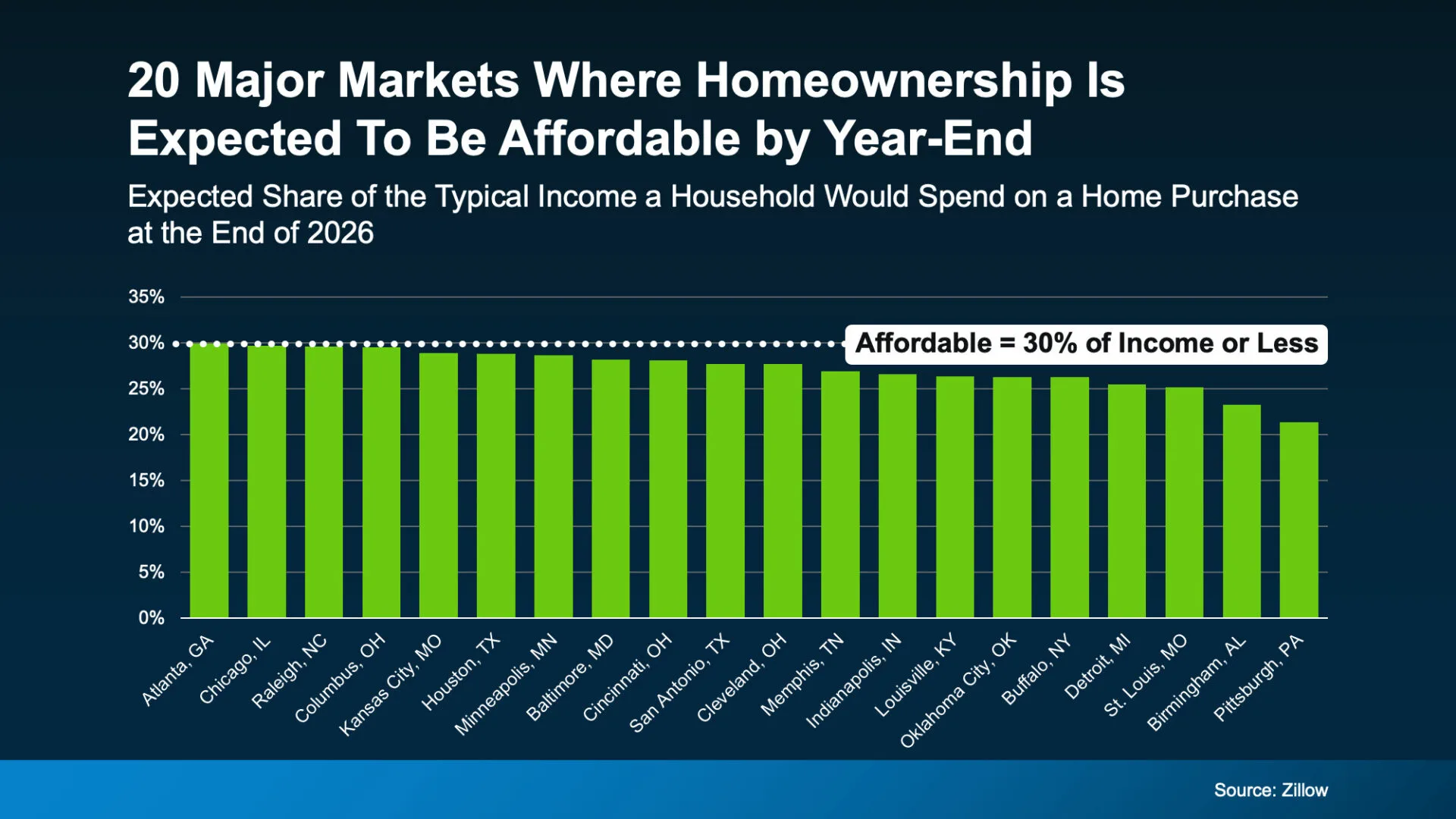
But how much is affordability really going to improve? In some places, noticeably. Zillow says some markets are expected to fall back under their affordability threshold (30% of your income or less) by the end of the year:
a graph of the average homeowners

But that doesn’t mean you have to be in one of these markets or wait until year-end to buy. Other places are already seeing big improvements in affordability. So, talk to a local agent about what’s happening in your market. You may find you’re able to buy after all.

Bottom Line

For the first time in quite a whole, affordability is easing. That’s a meaningful shift.

And because this improvement isn’t happening everywhere at the same speed, understanding what’s changing locally is what really makes a difference. If you want to see how these trends show up in your area, talk with a local real estate agent.
Written by Dr Jan Duffy REALTOR · Categorized: Uncategorized

Feb 02 2026

Home Insurance Costs Are Rising: What Buyers Should Plan For

Buying a home is one of the biggest purchases you’ll ever make. And homeowner’s insurance is what protects that investment. Think of it as your safety net. NerdWallet explains it:

  • Covers Repairs and Rebuilding Costs: If your home is damaged by fire, storms, or other covered events, it helps pay for repairs and possibly even a full rebuild, if that’s deemed necessary.
  • Protects Your Belongings: It can also cover personal items like furniture, electronics, jewelry, and clothing if they’re stolen or damaged.
  • Provides Liability Coverage: And, if someone gets injured on your property, your policy can help cover medical bills or legal expenses.

But that peace of mind does come with a cost, and lately those costs have been rising.

Why Home Insurance Premiums Are Going Up

There are a number of factors causing insurance premiums to rise today. But, in the simplest sense, here’s what’s driving prices up according to the Insurance Research Council (IRC).

Severe weather events and natural disasters are happening increasingly often, leading to more claims. At the same time, homebuilding materials and labor are more expensive. So, when it comes time to work on those claims, insurers have to manage higher costs to repair or rebuild the affected homes.

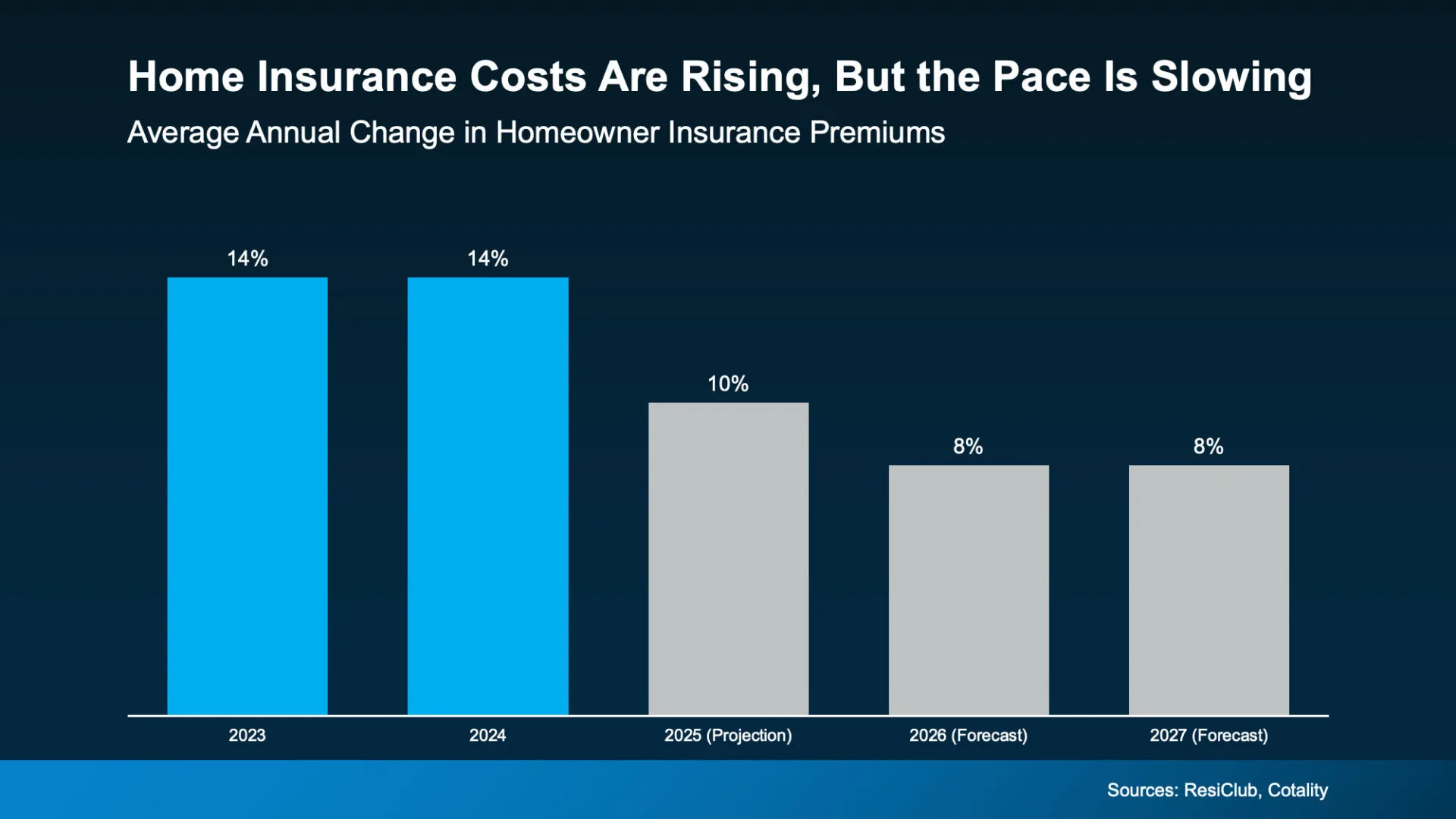
That combination adds up to higher premiums. You can see how it’s climbed recently in the graph below. Each bar marks the percentage increase in insurance costs for that calendar year.

a graph of a graph showing the cost of homeowner insuranceThe good news is, the annual pace of the increase may be starting to ease according to ResiClub and Cotality. By their count:

  • In 2023 and 2024, insurance costs went up 14% a year.
  • In 2025, they rose about 10%.
  • And in 2026 and 2027, it’s expected to go up about 8% each year.

That’s still an increase, but at least the pace is slowing down. And here’s another silver lining.

While insurance costs are rising, mortgage rates are falling. And that can help offset some of this expense. As Michael Gaines, Senior VP of Capital Markets, Cardinal Financial, explains:

“Rising taxes and insurance do create pressure, but they don’t erase the benefits of a lower rate . . . A small rate improvement, paired with the right loan program and smart planning, can still make homeownership possible . . . It’s less about one factor canceling another out, and more about helping buyers layer the right solutions together.”

Costs Are Going To Be Different Depending on Where You Buy

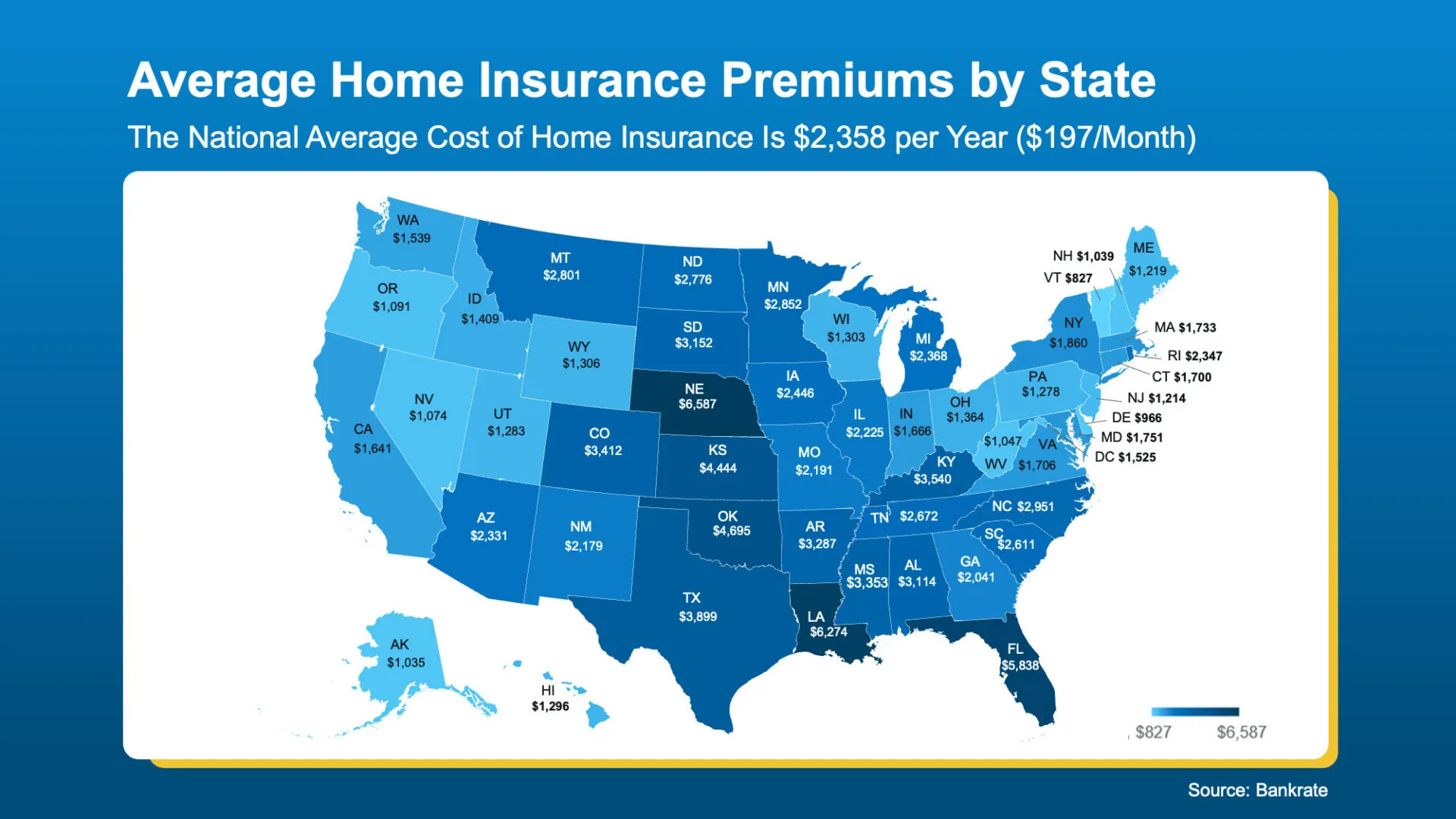
So how much do you need to budget for this? It depends on the price point and location of house, the coverage you need, and more. And just like with everything else in real estate, costs vary by area.

You can get a rough idea of your state’s typical premiums in the map below:

So, What Can You Do About It?

Generally speaking, your first insurance payment will be wrapped into your closing costs. But after that, it’ll become a recurring expense. That’s why knowing these premiums are rising is so important. It helps you factor that into your budget, so you go in with a full picture of what you can comfortably afford.

If you’re crunching the numbers and trying to find other ways to save, here are a few tips from Insurify and NerdWallet that can help you get the best insurance price possible:

  • Shop Around – Compare quotes from multiple companies.
  • Bundle Policies – Combine home and auto for discounts.
  • Ask About Discounts – Don’t miss out on savings you may qualify for.
  • Highlight Upgrades – Features like a new roof or storm windows can cut costs.
  • Improve Your Credit – A stronger credit score can mean better premiums.

Bottom Line

If you’re thinking about buying a home, don’t forget to plan ahead for your homeowner’s insurance.

While costs are rising, knowing what to expect and how to shop around can make a big difference as you’re budgeting for your purchase. Because this isn’t coverage you’ll want to skimp on. It’s your best protection for what’s likely your biggest investment.

Written by Dr Jan Duffy REALTOR · Categorized: Uncategorized

  • « Go to Previous Page
  • Page 1
  • Page 2
  • Page 3

Primary Sidebar

Testimonials on Las Vegas Home Search

You may have seen headlines on social saying the number of buyers backing out of their contracts is on the rise – and has recently reached a high not seen since 2017. That can sound intimidating. But it varies a lot by market.

And here’s the key thing to understand if you want to sell. A lot of the time, there’s one common cause. And it’s something you can actually control.

Here’s what you can do to get ahead of the biggest dealbreaker before it ever becomes a problem.

The Top Dealbreaker: Issues That Pop Up During the Inspection

A Redfin survey shows over 70% of recently cancelled contracts happened because of issues during the home inspection (see graph below): 

a screenshot of a surveyAnd that makes sense. Because today’s buyers have something they didn’t have a couple of years ago: options.

Why Fixing Things Before You List Matters More Today

A few years back, when buyers felt rushed or boxed in due to the limited number of homes for sale, they were more willing to overlook issues.

But in today’s market, skipping essential repairs is one of the fastest ways to lose a deal.

Now that there are more homes to choose from, buyers can be more selective. If a house feels risky, outdated, or like it’s hiding expensive surprises, they’re a lot more likely to walk away. So, what do you have to fix? Just ask an agent.

How Your Agent Can Help Give You the Edge

A local agent will be able to walk through your house and offer advice on what to tackle based on your specific home, your market, and what buyers are prioritizing in your area. They’ll also have first-hand knowledge about some of the biggest turnoffs for buyers today. And you can use that expertise to prevent future headaches.

For example, according to Zillow, these are some of the issues buyers will care the most about:

  • Roof leaks or damage: sagging, leaking, etc.
  • Plumbing problems: standing water, leaks, water damage, etc.
  • Electrical concerns: outdated or exposed wiring, missing GFCI outlets, etc.
  • HVAC issues: non-functioning units
  • Pest or insect damage: termite colonies, etc.
  • Hazardous materials: lead, mold, asbestos, etc.
  • Safety/code violations: missing smoke detectors, windows stuck closed, etc.
  • Structural problems: cracks in the foundation, sagging floors, etc.


Odds are not all of this even applies to your house. Maybe only 1-2 things do. Or maybe none of them do. It just depends. But an agent will have the tools and resources to help you figure it out and stay one step ahead.

The Benefits of a Pre-Listing Inspection

To buyers, these aren’t cosmetic issues. They’re trust issues. And that’s what you need to watch out for today. Once buyers start wondering “what else might be wrong,” it’s hard to recover momentum.

That’s why some agents are even recommending a pre-listing inspection as a sneak peek into what buyers will see on their own inspection. With that insight, you can:

  • Fix concerns before you list, or disclose issues upfront
  • Avoid having to respond or negotiate under pressure
  • Stop scrambling to find contractors with availability before your closing date

But remember, you don’t have to fix everything. You just have to be strategic about what you do tackle, so you and your buyer aren’t caught off guard.

And that’s why you need an agent who can:

  • Decide if a pre-listing inspection is worth it where you live
  • Recommend a trusted inspector (if you decide to get one)
  • Look at the results with you to identify true dealbreakers in your market
  • Help you decide what to fix or what to credit
  • Make sure you avoid over-spending or under-preparing

Bottom Line

One of the biggest dealbreakers for buyers today is inspection issues – and that’s something you can control. You just need to be proactive about high-impact repairs before you list.

If you want help figuring out where to focus, connect with an agent.

  • One Key Sign We’re Not Headed for a Wave of Foreclosures
  • If Your House Isn’t Getting Offers, Read This.
  • Should You Wait for Lower Rates?
  • Spring Sellers Have an Edge. Here’s Why.
  • Are Home Prices Dropping? Here’s the Real Story.

Footer

RSS Find a Home In Las Vegas Weekly News You Can Use

  • The #1 Reason Buyers Walk Away (And How To Get Ahead of It) March 16, 2026
    You may have seen headlines on social saying the number of buyers backing out of their contracts is on the rise – and has recently reached a high not seen since 2017.
  • One Key Sign We’re Not Headed for a Wave of Foreclosures March 12, 2026
    Foreclosures are ticking up. And that may make your mind jump straight to thoughts of 2008 – specifically to what happened to the market during the housing crash.
  • If Your House Isn’t Getting Offers, Read This. March 11, 2026
    Online searches for “can’t sell house” just hit an all-time high according to Google Trends.
  • Should You Wait for Lower Rates? March 9, 2026
    Mortgage rates have already dropped into the upper 5s twice this year. But after just a few days, they ticked back up into the low 6% range.
  • Spring Sellers Have an Edge. Here’s Why. March 5, 2026
    Homeowners looking to sell usually want three things: plenty of interested buyers, strong offers, and a short timeline. Spring is the season that most often delivers all three.
  • Sellers
  • Services
  • About Us
  • Search
  • Faq
  • Blog
  • Contact

Berkshire Hathaway HomeServices Nevada Properties

Your Trusted Las Vegas Real Estate Experts

Our Offices

Centennial Hills

9406 Del Webb Boulevard,
Las Vegas, NV 89134

(702) 718-0043

Henderson

3185 St Rose Pkwy, Suite 101,
Henderson, NV 89052

(702) 500-1955

Sahara

7475 W Sahara Ave # 100,
Las Vegas, NV 89117

(702) 299-6607

Sunset

8850 W Sunset Rd UNIT 200,
Las Vegas, NV 89148

(702) 500-1942

Summerlin

10777 W Twain Ave # 333,
Las Vegas, NV 89135

(702) 842-0410

Northwest

1490 Center Crossing Rd,
Las Vegas, NV 89144

(702) 678-9012

Downtown Las Vegas Condos & Homes

921 South Main Street,
Las Vegas, NV 89101

(702) 500-1980

Our Services

  • Residential Sales
  • Commercial Properties
  • Investment Opportunities
  • Property Valuation
About Us Blog Privacy Policy Terms of Service Contact Us
© Berkshire Hathaway HomeServices Nevada Property. All Rights Reserved.