• Skip to main content
  • Skip to primary sidebar
  • Skip to footer

Las Vegas Strip Luxury Real Estate

Luxury High-Rise Specialist with 30+ Years Experience

  • Discover Amazing Las Vegas Strip High Rises
  • Buy
    • Find A Home In Las Vegas
    • How to Buy a Home in Las Vegas
  • Home Evaluation
  • Properties
  • About Us
  • Faq
  • Resources
  • Blog
You are here: Home / Archives for Dr Jan Duffy REALTOR

Dr Jan Duffy REALTOR

Jan 22 2026

Mortgage Rates Recently Hit a 3-Year Low. Here’s Why That’s Still a Big Deal.

If you’re one of the thousands of homebuyers waiting for rates to fall, you should know it’s already happening. And they recently crossed an important milestone. Rates officially dipped their toes into the 5s – something that hasn’t happened in about 3 years.

This moment marked a critical threshold. Now, rates are sitting in the low 6% territory. And expert forecasts project they’ll hover near this range throughout the year.

Here’s why that’s so good for you.

Why Current Rates Are Such a Big Deal

A mortgage rate doesn’t just affect the interest you end up paying on your home loan. It shapes your entire buying experience.

When rates were up around 7% just one year ago, a lot of buyers felt priced out. Payments were higher. Budgets felt tighter. Affordability was a bigger challenge. That’s especially true for first-time homebuyers, who felt the biggest pinch.

But according to industry experts, that’s starting to change now that rates are slowly inching down. Let’s break down why.

Right now, borrowing costs are in their lowest range in almost 3 years. And that can change the type of home you can afford.

At 6% or below, you’ll see:

  • Lower monthly payments. The payment on a $400k home loan is down over $300 compared to when rates were around 7%.
  • More buying power, thanks to the extra breathing room in your budget.

In other words, you can now make a stronger offer, purchase in a different location, or buy a home that checks more of your boxes. And that feels like a big shift compared to when rates were at 7%.

This Opens the Door for 550,000 Buyers

To drive home just how much this helps potential homebuyers like you, consider this research from the National Association of Realtors (NAR). It shows that when mortgage rates sit around this level, millions more households can afford a home. When rates are at 6% or below:

  • 5.5 million more households can afford the median-priced home
  • And roughly 550,000 of those people will likely buy a home within 12 to 18 months

That’s not just speculation. That’s pent-up demand finally getting the green light they’ve been waiting for. You’ve got the chance right now to get ahead and buy before more people notice the game has just changed.

Because whether rates stay in the low 6s or dip back down into the upper 5s, the math is already working in your favor. And the difference from a low 6% to a high 5% isn’t as big as you may think. But the difference from 7% to 6%? That is very much a big deal, and it’s a number that’s already working in your favor.

An Important Call Out

Mortgage rates don’t operate in a vacuum. Home prices, local inventory, property taxes, home insurance, and your personal finances still matter.

And a rate in this territory doesn’t mean every home suddenly works for every buyer. That’s why getting pre-approved and running your numbers with a trusted lender is key.

Still, this rate environment puts more buyers in play than we’ve seen in years. So, if buying didn’t work for you before, it’s worth taking another look.

Bottom Line

Mortgage rates dropping to a 3-year low isn’t just a headline.

For many buyers, where rates are now could be the difference between watching from the sidelines and finally getting the keys to their next home.

If you’ve been waiting for a sign to re-run your numbers and see what’s possible now, this is it.

Connect with a lender to take a look at what today’s rates mean for your budget and your options.
Written by Dr Jan Duffy REALTOR · Categorized: Uncategorized

Jan 21 2026

Why Rising Foreclosure Headlines Aren’t a Red Flag for Today’s Housing Market

If you’ve seen headlines saying foreclosure activity has been climbing for 10 straight months, it’s easy to assume that’s a sign of trouble for the housing market. But when you look at the full picture, a few simple truths become clear:

  • Today’s foreclosure numbers are in line with what’s considered normal
  • High home equity is keeping most homeowners in a strong financial position
  • None of the data points to a big wave of distressed sales that’ll crash the market

Foreclosure Filings Are Up 32%, But That Doesn’t Mean the Market’s in Trouble

If you peel the layers all the way back, what everyone is actually worried about is that we’re headed for a repeat of what happened in 2008. Back then, riskier lending practices and an oversupply of homes for sale brought home prices down and led to a significant increase in foreclosures. A lot of people felt the impact. But this isn’t the same situation.

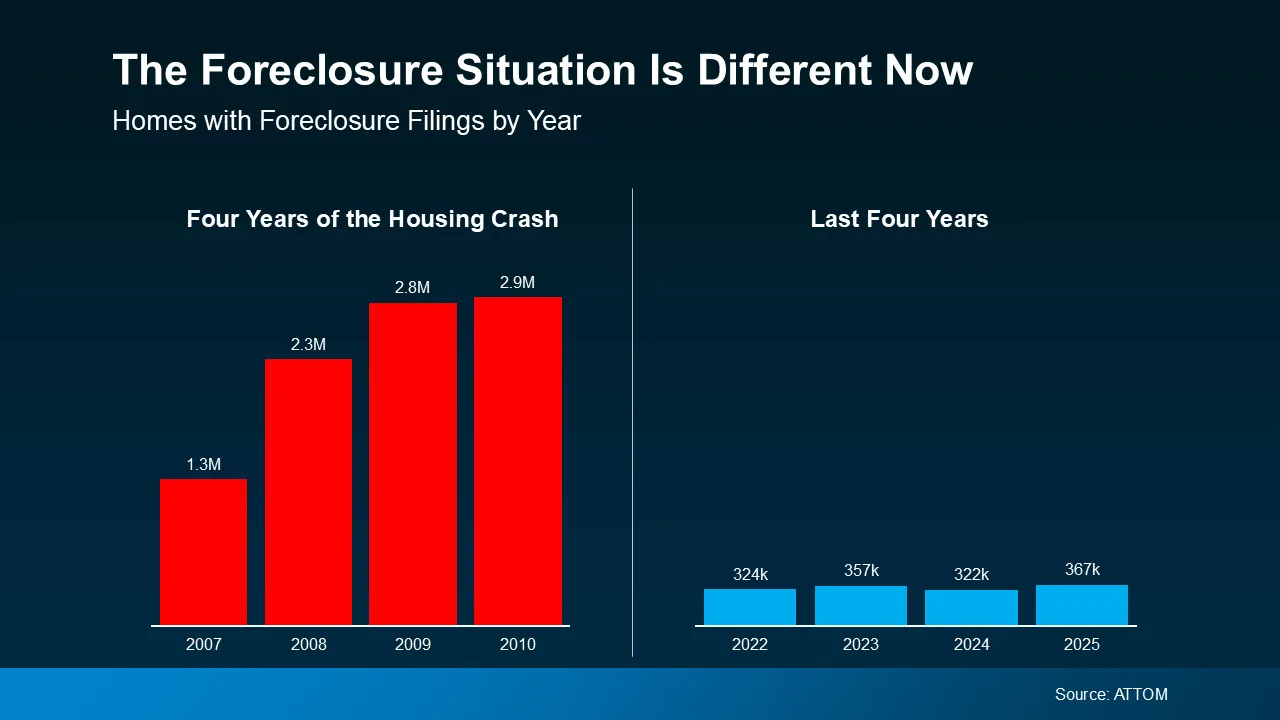
Yes, ATTOM data shows foreclosure filings are up 32% year-over-year. And that increase is going to sound dramatic. But context matters, and it doesn’t mean we’re headed for another crash. And the numbers prove it. Take a look at where we were during the last crash (the red in the graph below). And where we are now (the blue):

a graph of a graph showing the number of yearsEven with the uptick lately, we are still nowhere near crash levels – far from it. This isn’t a return to crisis levels. What it is, is a return to normal.

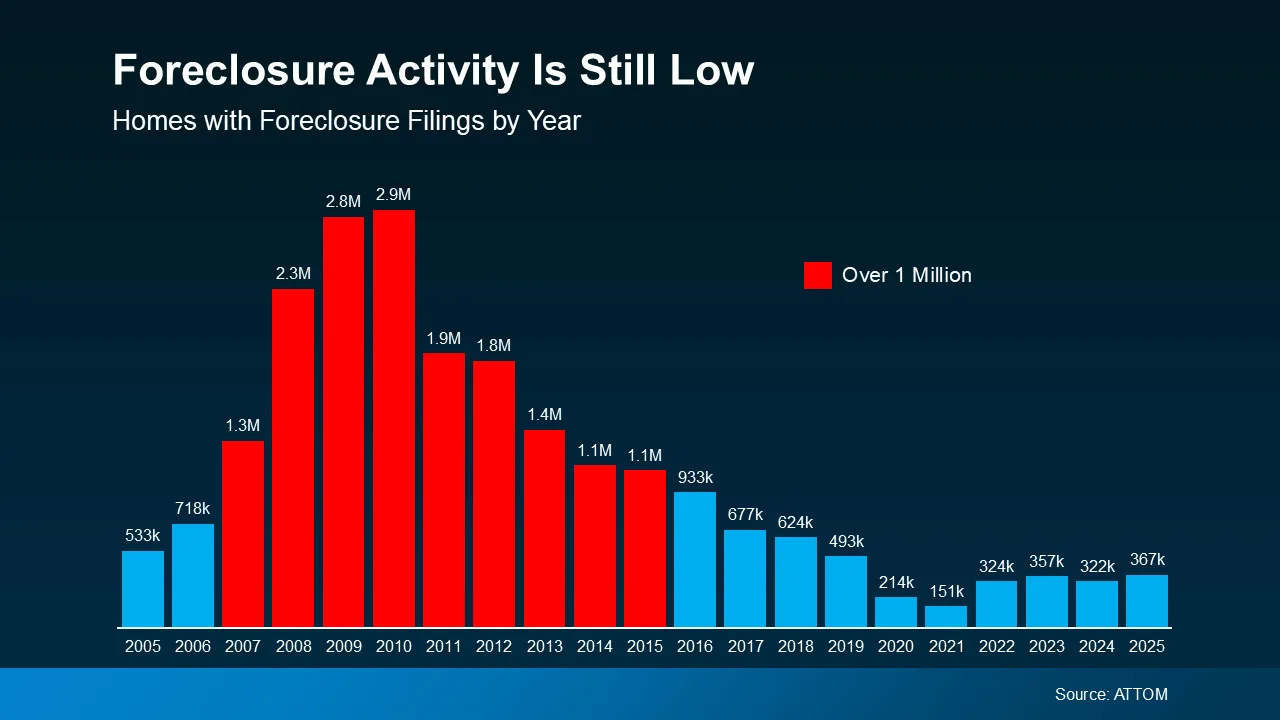
The graph below shows foreclosure filings going all the way back to early 2005. The lead up to, and the aftermath of, the crash is there in red. Those are the years when foreclosure filings went above the 1 million mark each year.

Now, look at the right side and scan back to the 2017–2019 range (the last truly normal years for housing). You’ll see we’re actually just starting to fall back in line with what’s typical for the market, even with the increase lately:

a graph of a number of peopleRob Barber, CEO at ATTOM, explains it well:

“Foreclosure activity increased in 2025, reflecting a continued normalization of the housing market following several years of historically low levels . . . While filings, starts, and repossessions all rose compared to 2024, foreclosure activity remains well below pre-pandemic norms and a fraction of what we saw during the last housing crisis . . . today’s uptick is being driven more by market recalibration than widespread homeowner distress, with strong equity positions and more disciplined lending continuing to limit risk.”

The word “normalization” in that quote is extra important. While economic and financial pressures are putting a strain on some homeowners, this isn’t a flood of distressed homes. No matter what the headlines may have you believe, this isn’t a large-scale crisis.

Today’s increase isn’t a sign of trouble. It’s a return to normal.

Why This Isn’t a Repeat of 2008

Even though the last housing crash still shapes how a lot of people interpret today’s news, the reality is, this is a different market:

  • Lending standards are stronger
  • Borrowers are more qualified
  • And homeowners have far more equity

And that equity piece is especially important. Over the last five years, home prices have risen significantly. For many people, their house is worth far more than they paid for it. That means most homeowners have a strong financial cushion to fall back on, if needed.

Basically, if someone faces hardship today, they often have the option to sell, and maybe even walk away with money in their pocket, instead of going through foreclosure. That’s a major contrast to 2008, when many homeowners owed more than their home was worth. 

Bottom Line

Foreclosure activity may be rising, but it’s still well within a normal range – and nowhere close to the danger zones of the past. But the headlines are doing more to terrify than clarify. And that’s exactly why having a trusted real estate expert you can call on is so important.

When you hear something in the news or see something on social about housing that worries you, reach out to a local agent. An expert will have the context needed to explain what’s really happening and how it impacts you (if at all). 

Written by Dr Jan Duffy REALTOR · Categorized: Uncategorized

Jan 19 2026

Home Updates That Actually Pay You Back When You Sell

Planning to sell this spring? While you may be tempted to hold off until the first blooms or the spring showers hit, that’s actually waiting too long to get started by today’s standards.

Buyers have more options than they did a few years ago. So, it’s worth it to tackle repairs now and make sure your house is set up to stand out. Because you don’t want to be caught scrambling right before the spring rush. Or, running out of time to do the work your house really needs. 

The key is focusing on updates that actually matter. And that’s exactly where return-on-investment (ROI) data comes in handy.

Which Projects Tend to Pay Off?

Every year, Zonda looks at which home improvements deliver the most bang for the buck when you go to sell the home. And the results can be a little surprising.

The green in the chart below shows the updates where sellers have the biggest potential to add value based on that research:

a graph of a graph of a companyWhile there’s a wide range of projects represented in this data, the cool part is, some of the top winners aren’t big to-do’s. They’re just swapping out doors.

Small Updates, Big Visual Impact

This goes to show little projects can have a big impact. So, you don’t have to spend a fortune. And you don’t need to tackle everything on this list. But in today’s market, doing nothing can work against you.

Now that buyers have more homes to choose from, a lot of them are going to opt for what’s move-in ready.

The best advice? Focus on what your house needs, whether it’s listed here or not – like the repairs you’ve been putting off. A front door or shutters in need of a little TLC. Piles of leaves in the yard. Scuffed up paint where your kids play inside. Those details matter too.

Mallory Slesser, Interior designer and Home Stager, explains it to the National Association of Realtors (NAR) this way:

“If you’re looking for affordable updates that pack a punch, dollar for dollar, I would say painting; changing out light fixtures; changing out hardware; maybe new draperies or window treatments. Those are all cost-effective ways to make a big statement. It really changes the space.”

These seemingly small things help buyers focus on the home itself – not the work they think they’ll have to do after moving in. And that’s paying off for other sellers. Buyers are often willing to spend more on homes that feel well cared for, updated, and move-in ready.

This Chart Is a Starting Point, Not a Strategy

Here’s the important thing to remember. National data like this is a guideline. Buyer preferences are going to vary by location, price point, and even neighborhood. That means a project that boosts value in one area might be unnecessary (or even overkill) in yours.

That’s why the first step should always be to talk with a local real estate professional before you start.

An experienced agent can help you answer questions like:

  • Which updates do buyers in your market expect?
  • What can you skip without hurting your sale?
  • Where will a small investment make the biggest difference?
  • Is it better to update, or sell as-is?

That guidance helps you avoid over-improving and under-preparing.

Bottom Line

If you’re looking to sell this spring, you still have time to make updates that help your home stand out – without taking on a full renovation.

If you’re not sure where to start, talk to a local about what makes sense for your house. A quick conversation can help you prioritize the updates that’ll pack the biggest punch.

What’s one upgrade you’ve been thinking about – and wondering if it’s worth it?

Written by Dr Jan Duffy REALTOR · Categorized: Uncategorized

Jan 15 2026

Are Big Investors Really Buying Up All the Homes? Here’s the Truth.

It’s hard to scroll online lately without seeing some version of this claim:

“Big investors are buying up all the homes.”

And honestly, if you’re a homebuyer who’s lost out on a few offers, that idea probably sounds believable. When homes are expensive and competition is tight, it’s easy to assume giant companies are scooping everything up behind the scenes.

But here’s the thing: what people assume is happening and what the data actually shows aren’t always the same.

Let’s look at what’s really happening with large institutional investors in today’s housing market – because the numbers tell a much different story than the headlines.

The Number Most People Won’t See Online

Let’s start with the most important stat. According to John Burns Research & Consulting (JBREC), large institutional investors – those that own 100 or more homes – made up just 1.2% of all home purchases in Q3 of 2025 (see graph below):

a graph of salesThat’s it. Out of every 100 homes sold, only about 1 went to a large institutional investor.

And here’s an important point that often gets missed: that level of investor activity is very much in line with historical norms. It’s not unusually high, and it’s actually well below the recent peak of 3.1% back in 2022 – which itself was still a small share of the overall market.

So, while it can feel like big investors are everywhere, nationally, they’re a very small part of overall home sales.

Why Investor Activity Gets So Much Attention

There are two main reasons this topic gets so much attention:

  1. Investor activity isn’t spread evenly.Investors are more active in certain markets, which can make competition feel intense for homebuyers in those areas. As Lance Lambert, Co-Founder of ResiClub, explains:“On a national level, “large investors”—those owning at least 100 single-family homes—only own around 1% of total single-family housing stock. That said, in a handful of regional housing markets, institutional and large single-family landlords have a much larger presence.”
  2. Investor is a broad term.Part of what makes the share of purchases bought by investors sound so big is because many headlines lump large Wall Street institutions together with small, local investors (like your neighbor who owns one or two rental homes). But those are very different buyers.In reality, most investors are small, local owners, not massive corporations. And when all investors get grouped together in the headlines as a single stat, it inflates the number and makes it seem like big institutions are dominating the market (even though they’re not).

Yes, big investors exist. Yes, they buy homes. But nationally, they’re responsible for a very small share of total purchases – far smaller than most people assume.

The bigger challenges around affordability have much more to do with supply, demand, and years of underbuilding than with large institutions competing against everyday buyers.

That’s why it’s so important to separate noise from reality, especially if you’re trying to decide if now is the right time to move.

Bottom Line

If you want to talk through what investor activity actually looks like in our local market, and how it impacts your options (or doesn’t), connect with a local real estate agent.

Sometimes a little context makes all the difference.

Written by Dr Jan Duffy REALTOR · Categorized: Uncategorized

Jan 14 2026

The #1 Regret Sellers Have When They Don’t Use an Agent

Want to know the #1 thing homeowners regret when they sell without an agent? It’s that they didn’t price their house correctly for their current market.

According to the latest data from the National Association of Realtors (NAR), those sellers agree pricing their home effectively was the hardest part of the process.

Top 5 Most Difficult Task for Sellers Who Didn’t Use an Agent:

  1. Getting the price right
  2. Preparing or fixing up the house
  3. Selling within the desired time frame
  4. Handling all the legal documents
  5. Finding the time to manage all aspects of the sale

And that makes sense. Pricing isn’t as simple as picking a number from an online estimate or copying what your neighbor got last year. It takes real insight into:

  • What buyers are actually willing to pay today
  • How much competition you have in your area
  • What similar homes nearby are really selling for
  • How desirable your area or neighborhood is
  • The condition of your house

Without that context, it’s easy to overshoot the mark, especially now that buyers can be more selective. And in today’s market, that’ll backfire.

Overpricing Isn’t a Small Mistake, It Snowballs

Your price is part of what shapes a buyer’s first impression. And when it’s too high, a chain reaction begins.

If buyers think you’re asking too much, they’re going to turn the other way. And when buyers bypass your house, you’ll get fewer showings. Fewer showings lead to fewer offers. And fewer offers usually mean making a price cut to try to draw buyers back in.

And that’s happening a lot lately, especially on homes sold without a pro.

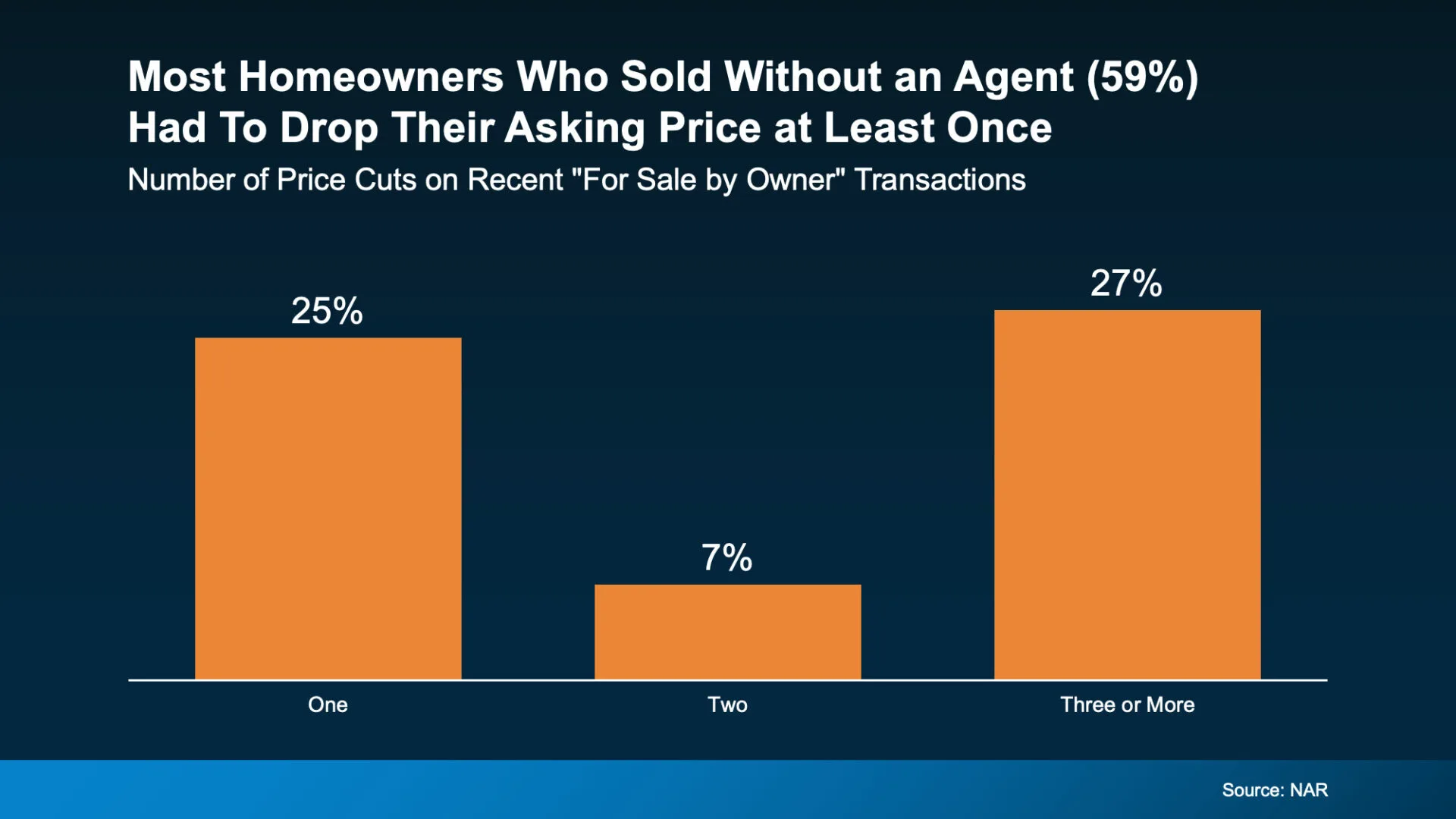
The same NAR report shows most homes sold without an agent (59%) had to reduce their asking price at least once (see the orange in the graph below).

The Part Sellers Don’t See Coming

The trouble is, price cuts don’t always fix the problem. They can attract bargain hunters rather than strong, confident buyers. That’s because many buyers see a price drop as a sign there’s something wrong with the house. And that assumption can turn buyers away too.

By the time your house finally sells, you may net less than if you’d priced it correctly from the start. Again, the data backs this up.

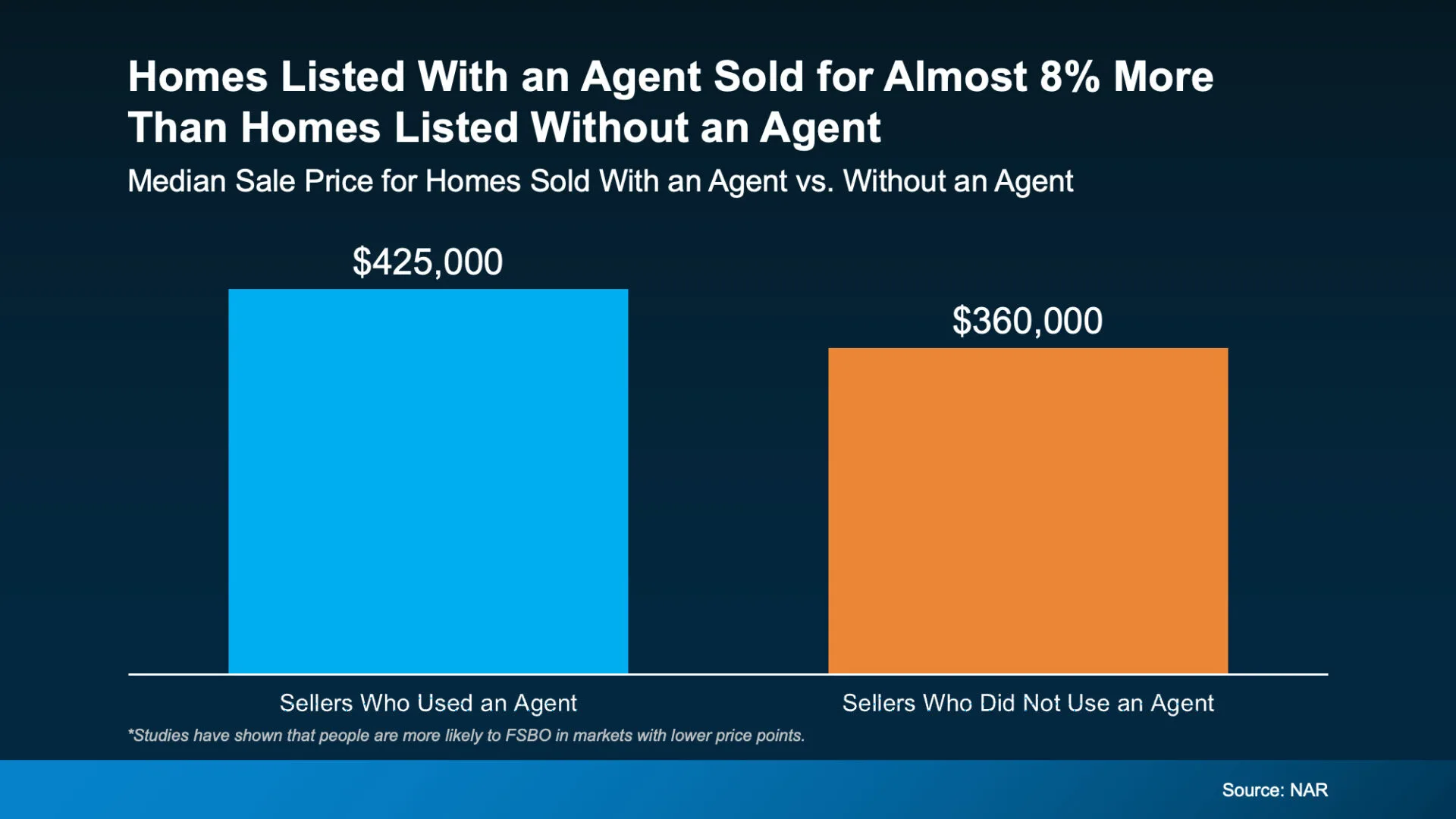
NAR shows that homes sold with an agent sell for nearly 8% more than homes sold without one.

a graph of sales and salesThat’s not because agents magically add value. It’s because they have the expertise needed to get it right. The price. The prep. The presentation. And the paperwork.

Nail all of that from day one, and you’ll be set up to get as much money as you can out of your sale.

So, even though you thought selling without an agent meant saving money, that’s not necessarily true. The facts show selling on your own can mean selling for less in the long run. And that may be enough to totally change your perspective.

Bottom Line

Today, the biggest risk of selling without an agent isn’t the paperwork or the hassle. It’s the price. And once pricing goes wrong, it’s hard to course correct.

So, if you’re thinking about selling and want to understand what your home would realistically go for in today’s market, connect with a local agent. A quick pricing conversation now can save you from much bigger regrets later.

Written by Dr Jan Duffy REALTOR · Categorized: Uncategorized

  • « Go to Previous Page
  • Page 1
  • Page 2
  • Page 3
  • Page 4
  • Interim pages omitted …
  • Page 74
  • Go to Next Page »

Primary Sidebar

Testimonials on Las Vegas Home Search

There’s finally a little good news for anyone who’s been priced out or sitting on the sidelines.

Buying a home is getting more affordable.

Monthly payments have started to come down, and the squeeze buyers have been feeling for the past few years is slowly loosening. Now, that doesn’t mean everyone can suddenly afford a home, but with how tough the market’s been, the improvement we’re seeing matters.

Affordability Is Finally Moving in the Right Direction

One of the best ways to see this shift is by looking at how much of a household’s income it takes to buy a home.

According to Zillow, housing is typically considered affordable when it takes 30% or less of your monthly income to cover your expenses. That includes your mortgage payment, taxes, insurance, and basic maintenance.

For the past few years, the math was well above that threshold, and it made buying a home unachievable for many. But now, we’re slowly moving back toward a balance. Zillow research shows it’s taking less of a typical household’s income to buy a home than it did just a few years ago (see graph below):

a graph with green line and white textNow, we’re not all the way back to Zillow’s threshold of 30% of your income or less, so affordability is still tight. But things are trending in the right direction.

Why Affordability Is Improving

So, what’s driving the change? A lot of the focus lately has been on mortgage rates and how much they’ve come down over the course of the past year. But that’s not the only factor working in favor of buyers right now. Here are three trends benefiting buyers today: 

1. Mortgage rates have eased. Rates are near their lowest level in more than three years, which helps lower monthly payments (see graph below):

a graph of a low interest rate

2. Home price growth has cooled. Prices aren’t falling nationally, but they’re growing much more slowly than they were a few years ago. That means buyers today aren’t facing the same sharp jumps in purchase prices, which helps keep monthly payments more manageable – and buying more predictable. 

3. Wages are growing faster than home prices. This one matters a lot. As Mark Fleming, Chief Economist at First American, explains:

“When income growth exceeds house price growth, house-buying power improves—even if mortgage rates don’t decline meaningfully.”

None of this makes buying cheap, but it does explain why the math is starting to work a little better for buyers than it did even a just a year ago. Put simply, the forces that hurt affordability over the past few years are finally easing. Fleming again explains it well:

“Affordability remains challenging, but for the first time in several years, the underlying forces are finally aligned toward gradual improvement. Mortgage rates may drift down only slowly, but income growth exceeding house price appreciation will provide a boost to house-buying power — even in a higher-rate world. Affordability won’t snap back overnight, but like a ship finally catching a steady tailwind, it’s now sailing in the right direction.”

These three factors combined are why economists expect affordability to keep improving in 2026.

Where Homes Are Becoming Affordable First

But how much is affordability really going to improve? In some places, noticeably. Zillow says some markets are expected to fall back under their affordability threshold (30% of your income or less) by the end of the year:

a graph of the average homeowners

But that doesn’t mean you have to be in one of these markets or wait until year-end to buy. Other places are already seeing big improvements in affordability. So, talk to a local agent about what’s happening in your market. You may find you’re able to buy after all.

Bottom Line

For the first time in quite a whole, affordability is easing. That’s a meaningful shift.

And because this improvement isn’t happening everywhere at the same speed, understanding what’s changing locally is what really makes a difference. If you want to see how these trends show up in your area, talk with a local real estate agent.

  • Home Insurance Costs Are Rising: What Buyers Should Plan For
  • Why So Many Homeowners Are Downsizing Right Now
  • Top 2026 Housing Markets for Buyers and Sellers
  • You May Not Want To Skip Over That House That’s Been Sitting on the Market
  • Mortgage Rates Recently Hit a 3-Year Low. Here’s Why That’s Still a Big Deal.

Footer

RSS Find a Home In Las Vegas Weekly News You Can Use

  • Top 3 Reasons To Buy a Home Before Spring February 5, 2026
    If you’re planning to buy a home this year, you may be focused on the spring market.
  • It’s Getting More Affordable To Buy a Home February 4, 2026
    There’s finally a little good news for anyone who’s been priced out or sitting on the sidelines.
  • Home Insurance Costs Are Rising: What Buyers Should Plan For February 2, 2026
    Buying a home is one of the biggest purchases you’ll ever make. And homeowner’s insurance is what protects that investment.
  • Why So Many Homeowners Are Downsizing Right Now January 29, 2026
    For a growing number of homeowners, retirement isn’t some distant idea anymore. It’s starting to feel very real. 
  • Top 2026 Housing Markets for Buyers and Sellers January 28, 2026
    Who doesn’t love a top 10 list? Well, here are two top 10 lists for the housing market this year.
  • Sellers
  • Services
  • About Us
  • Search
  • Faq
  • Blog
  • Contact

Berkshire Hathaway HomeServices Nevada Properties

Your Trusted Las Vegas Real Estate Experts

Our Offices

Centennial Hills

9406 Del Webb Boulevard,
Las Vegas, NV 89134

(702) 718-0043

Henderson

3185 St Rose Pkwy, Suite 101,
Henderson, NV 89052

(702) 500-1955

Sahara

7475 W Sahara Ave # 100,
Las Vegas, NV 89117

(702) 299-6607

Sunset

8850 W Sunset Rd UNIT 200,
Las Vegas, NV 89148

(702) 500-1942

Summerlin

10777 W Twain Ave # 333,
Las Vegas, NV 89135

(702) 842-0410

Northwest

1490 Center Crossing Rd,
Las Vegas, NV 89144

(702) 678-9012

Downtown Las Vegas Condos & Homes

921 South Main Street,
Las Vegas, NV 89101

(702) 500-1980

Our Services

  • Residential Sales
  • Commercial Properties
  • Investment Opportunities
  • Property Valuation
About Us Blog Privacy Policy Terms of Service Contact Us
© Berkshire Hathaway HomeServices Nevada Property. All Rights Reserved.